
The Creator Economy turned audiences into income.
The Founder Economy turns domain expertise into companies.
For 15 years, I’ve coached founders through the messy process of turning ideas into validated business models. In that time, I’ve watched three economic waves reshape who gets to build:
The Gig Economy (2010s) gave people flexibility. Drive when you want. Deliver when you want. But you were still renting out your time on someone else’s platform.
The Creator Economy (2020s) gave people leverage. Build an audience, monetize attention. But the ceiling was real — you were the product, and scaling meant more content, not more impact.
The Founder Economy (2025+) gives people ownership. Not of an audience — of a business model. Not content that earns while you sleep, but a company that creates value whether you post today or not.
Here’s what changed:
The barriers collapsed
Starting a company used to require three things most people didn’t have: a technical co-founder, $500K in capital, and 18 months of runway.
AI eliminated the first. Lean validation eliminated the second. And the third? If you validate before you build, you don’t need runway — you need evenings and weekends.
The minimum viable founding team is shrinking toward one.
The scarce resource shifted
When building was expensive, capital was the bottleneck. When building got cheap, execution was the bottleneck. Now that AI makes execution accessible to anyone, the bottleneck shifted again.
The scarce resource in the Founder Economy is problem clarity.
Who has the problem? How badly? Are they spending money on it today? Will they pay you to fix it? These questions can’t be prompt-engineered. They require domain expertise and customer conversations.
And that’s exactly what millions of employed professionals already have.
The 100X Founder
I’ve started calling them Latent Founders — the product managers, engineers, ops leaders, and consultants with 5-15 years of domain expertise who’ve been watching unsolved problems in their industries and thinking, “I could build that.”
They couldn’t — until now.
A funded team of 10 needs 6-12 months to learn what a domain expert already knows from Tuesday mornings. AI closes the execution gap. Lean methodology provides the validation framework. One person with deep domain knowledge and the right tools can move faster than a venture-backed team learning from scratch.
Not 100x the output. 100x the leverage.
Dario Amodei at Anthropic predicts billion-dollar one-person companies with “70-80% confidence.” Maor Shlomo built Base44 alone and sold it to Wix for $80M in 6 months. These aren’t anomalies. They’re early signals.
Creator vs. Founder
This isn’t a criticism of the Creator Economy. Justin Welsh and others built something real. But the distinction matters:
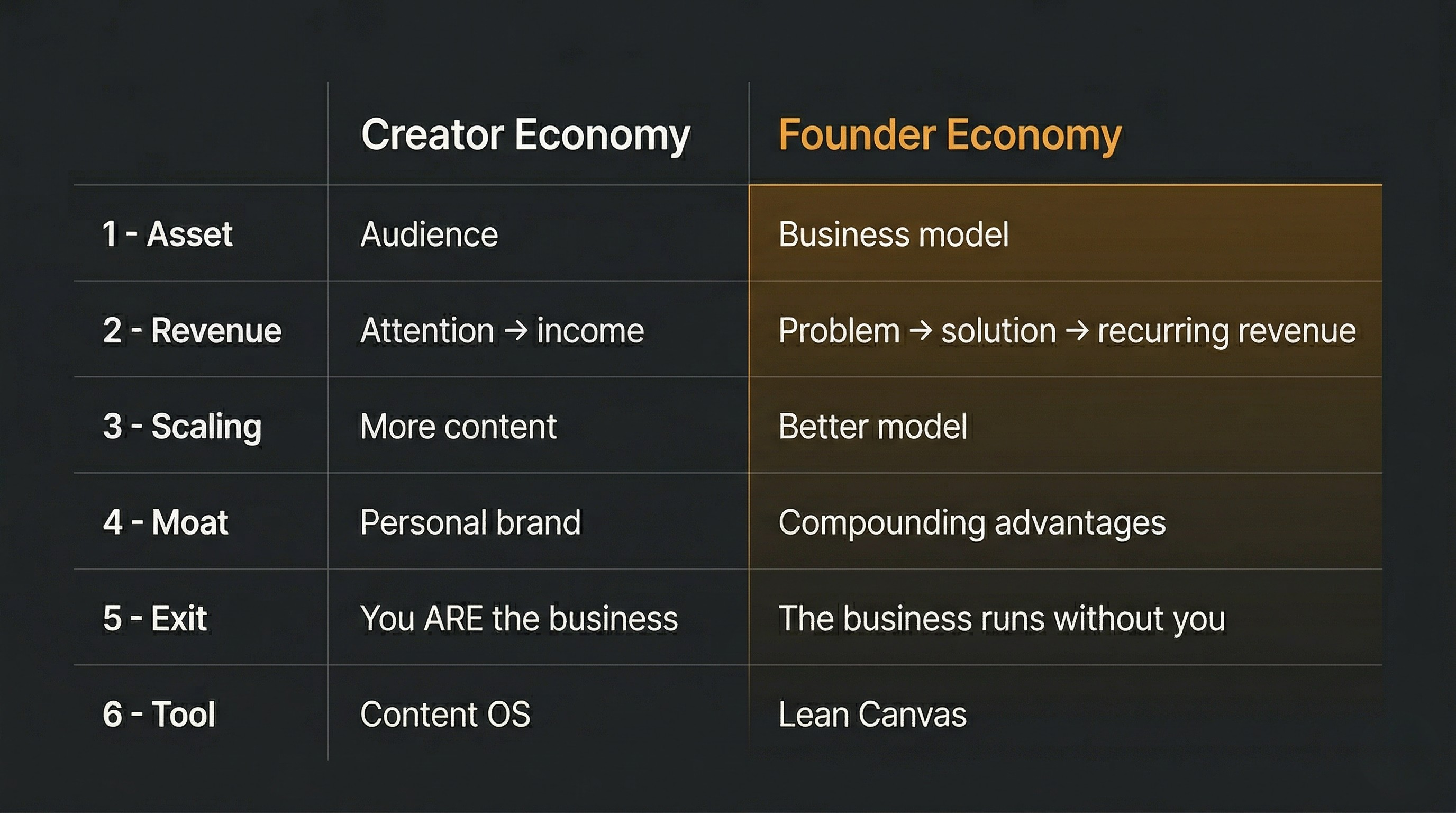
Creators build audiences. Founders build machines.
Both are valid. But if you have domain expertise and a problem worth solving, you’re not a creator — you’re a founder who hasn’t started yet.
The methodology matters more now
Here’s the counterintuitive part: AI makes the methodology more important, not less.
When building was slow and expensive, mistakes were naturally rate-limited. You couldn’t build the wrong thing very fast because building anything took months.
Now you can build the wrong thing in a weekend. AI gives you 10x the ability to build. It gives you 0x the clarity about what to build.
Speed without validation is just efficient failure.
The Founder Economy needs a system: Map your assumptions. Test the riskiest one first. Get evidence before you build. Iterate the model, not just the product. This is what the Lean Canvas, Demo-Sell-Build, and 90-day validation cycles were designed for — they just became 10x more urgent.
The invitation
If you’ve been sitting at your desk with an idea you can’t shake — redesigning your company’s product in your head during meetings, describing “what I would build” to friends, Googling “how to start a company while employed” — you’re not an employee with ideas.
You’re a Latent Founder.
The Founder Economy is the era where your domain expertise becomes your most valuable founding asset. The tools are here. The methodology exists. The cost of validating is approaching zero.
The only remaining question is whether you’ll use them.
Ash Maurya is the author of Running Lean and the creator of Lean Canvas. He has spent 15 years building the methodology for the Founder Economy — before it had a name.